Fascist Squads–Italian Socialists Relationship
M: Son of the CenturyThe Fascist Squads–Italian Socialists Relationship is portrayed as a conflict that moved from violent encounters in Milan into a wider contest over work, rural power, and the institutions capable of mobilizing ordinary people. Socialists entered the confrontation with established organizations and a mass constituency; the fascists answered through armed action, attacks on socialist institutions, and, increasingly, the support of agrarian interests and state authorities. Their struggle did not simply displace one political force with another: it made violence a means of reorganizing public life and gave the conflict a national as well as a local dimension.
Mass politics and the Milan confrontation
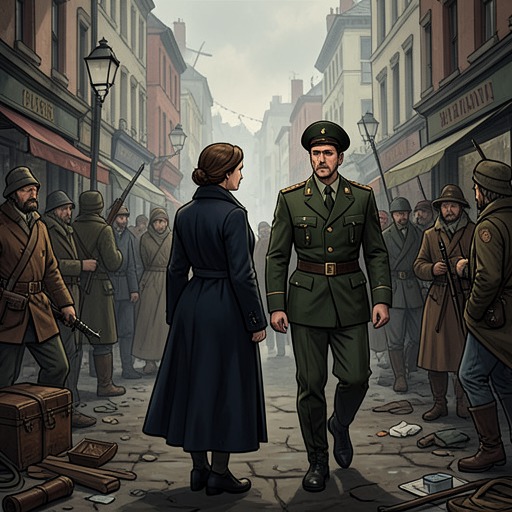
The relationship takes a defining form in Milan, where a socialist procession and a much smaller opposing column face one another behind a cordon of Carabinieri. Women lead the socialist march, carrying a portrait of Vladimir Lenin and a red flag; their demonstration is presented as a hopeful appeal for a better life for their children. On the other side stand men accustomed to wartime violence. The contrast in numbers, and in the groups’ different experiences of death, makes the encounter unequal even before the cordon opens.
When the officers move aside, the confrontation lasts roughly a minute. Socialists throw stones and a few clubs; shots fired by the opposing side first go into the air, then into the column. The marchers’ songs stop, and the crowd breaks apart in panic. The armed men advance and reload, while the retreating demonstrators are beaten. The episode shows how quickly a political demonstration could be transformed into an encounter governed by the armed side’s initiative: the socialists’ public presence and numbers did not protect them once the officers and their allies moved forward.
The attack continues beyond the street. After the clash, the assailants head for the Milan headquarters of Avanti!, the leading socialist newspaper, on Via San Damiano. Uniformed soldiers are guarding the building, but their resistance is hesitant; some of the activists had been their commanders during the war. When a guard is killed by a shot from inside, the attackers enter through the opening made for the stretcher. The socialist defenders have left by a rear exit. The building is then looted and deliberately wrecked: its presses, typewriters, files, and historical archive are among the targets, and its bound volumes are soaked with flammable liquid. By striking the newspaper as well as the marchers, the attackers turn political hostility into an assault on the means by which socialism records and circulates its ideas.
Labor conflict and rural power
The urban violence belongs to a broader struggle in which socialist organizations were already shaping economic life. In Bologna, labor chambers competed in revolutionary militancy, while union rules and political pressure reached into housing, access to bread, and employers’ decisions. In the countryside, socialist leagues exercised still greater influence. They organized workers and cooperatives, pressed landowners to accept collective labor agreements, and imposed penalties for breaches. The narrative presents this system as both a source of leverage for farmworkers and a severe constraint on people who rejected its rules.
The conflict was rooted in material conditions as well as political allegiance. In the Po Valley, agricultural laborers worked an average of only 120 days a year and depended on higher wages and access to employment to survive the idle months. The leagues’ influence extended from hiring offices to work shifts, threshing, seed supplies, and crop planting. In Ferrara, the spring disputes brought an agreement requiring landowners to hire five workers for every thirty hectares during the winter period; in the following account of the region, a winter arrangement required six. Such agreements were intended to secure work, but they also made control of labor a central political stake.
The narrative conveys the strain through a specific consequence of the summer 1920 labor conflict: harvested grain remained unthreshed in oppressive heat, while cows went unmilked after peasants shut the barn doors. The episode is not presented as an isolated rural disturbance. It belongs to a wider contest in which socialist leagues sought comprehensive control of agricultural work and opponents resisted rules they regarded as intolerable. Ferrara’s leagues counted 81,000 members at their first congress of proletarian unity, including farmworkers, tenants, sharecroppers, and small landowners. The organization’s size and reach help explain why the struggle drew not only political opponents but also landowners seeking to restore their authority.
Fascist organization and state cooperation
The fascists’ answer increasingly depended on organized force rather than isolated street action. A punitive expedition from Ferrara on January 23, 1921, was planned in military fashion. Dozens of armed men, using trucks provided by the Agrarian Association, set out to strike several rural leagues at once. The scale and coordination of the operation show how the conflict’s rural front had become an organized campaign against socialist institutions, supported by resources from agrarian interests.
State cooperation also altered the balance. Benito Mussolini arranged for the fasci to assist Milan’s prefect in maintaining public order. A confidential government circular then urged fascist collaboration in repressing revolutionary attempts, including by force, on the condition that the fascists accept command by the authorities. The liberal state thus enlisted the movement against the revolutionary left, giving the fascists an opening to act as public-order auxiliaries while opposing mass socialist action. The arrangement did not erase the tension between official authority and fascist force; it placed that force within a relationship of conditional cooperation.
The widening campaign had substantial organizational consequences. During 1921, raids by fascist squads contributed to the dissolution of 80 percent of northern Italy’s socialist and Catholic organizations, many of which were placed under prefectural administration. Some socialist mayors resigned under intimidation, and in Ferrara rural populations shifted collectively from the red leagues to fascist unions. The reversal demonstrates that the conflict concerned who could organize people and administer local life, not only who prevailed in a particular clash.
Political antagonism and its transformation
As the National Fascist Party took shape, its leader described fascism as capable of absorbing liberalism because violence had buried earlier methods. His program also promised to make Italians into a unified national people and treated the state as an instrument of fascist authority. This language recast the confrontation with socialism: instead of a dispute between rival organizations alone, it became part of a claim that fascism could absorb political differences and reorganize the nation. The claim to represent the masses coexisted with a stated intention to educate and discipline them, a contrast that clarifies the unequal terms of the proposed political unity.
A later image of fascist revival gathers the movement’s growth into a story of transformation: small groups have become legions, volunteers have become a people, and the people are said to be becoming a nation and a state. Against that account stands the earlier evidence of socialist organizations, labor disputes, and demonstrations being broken by force. The relationship therefore develops not toward reconciliation but toward the defeat and absorption of socialist public power. Its decisive significance lies in this change of scale: violence that first appears on Milan’s streets becomes part of a broader contest over labor, local administration, and the state itself.